The CWE Top 25 ranks the most dangerous and prevalent software weaknesses behind real-world breaches. QSECS tests your application and codebase against each one, turning abstract weakness classes into concrete, exploitable findings your engineers can fix.
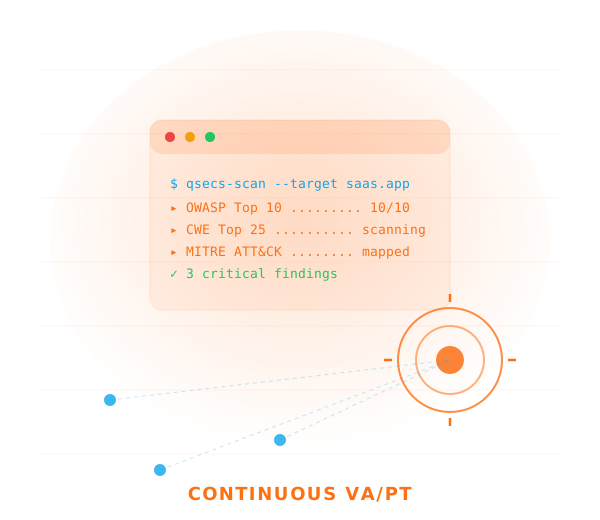
We evaluate your software for the weakness classes MITRE ranks as the most dangerous, prioritised by real exploitability in your environment.
Where the OWASP Top 10 describes risk categories, the CWE Top 25 names the specific software weaknesses — the coding and design flaws — those risks are built on. It is the language your developers already use to classify and fix defects.
QSECS tests your application and codebase against each weakness class, tracing it from the vulnerable line of code to a working exploit. Every finding lands with a precise CWE identifier, so remediation is unambiguous and verifiable.
Memory-safety and input-handling weaknesses such as out-of-bounds access, buffer issues and improper validation
Injection-class weaknesses (CWE-79, CWE-89, CWE-78) traced from source to sink in your code
Improper authentication, authorization and credential-management weaknesses
Insecure deserialization, SSRF and path-traversal weaknesses across services and integrations
Use of components with known vulnerabilities and unsafe default configurations
The CWE Top 25 Meets a Federal Deadline
The CWE Top 25 catalogues the software weaknesses attackers exploit most — including the cryptographic and authentication flaws a quantum adversary will weaponise. Executive Order 14412, "Securing the Nation Against Advanced Cryptographic Attacks," sets legally binding federal deadlines to adopt post-quantum cryptography: key establishment by December 31, 2030 and digital signatures by December 31, 2031. Eliminating those weakness classes faster than your developers reintroduce them demands testing that never stops, not a point-in-time review. An autonomous service like QRedSentinel keeps pace with your developers, re-testing every change so those weakness classes can never quietly creep back in.
We combine code-aware analysis with hands-on exploitation so each weakness is confirmed, not just flagged.
We map findings to precise CWE identifiers, giving developers an unambiguous, standards-aligned defect to fix
We trace each weakness from the vulnerable code path to a working proof of concept against the running application
We prioritise by real-world exploitability and business impact rather than raw weakness counts
We deliver Generative AI-supported remediation with secure-coding patterns specific to your language and framework
We verify fixes on retest to ensure the underlying weakness class is eliminated, not relocated