The OWASP Top 10 is the industry's consensus list of the most critical web application security risks. QSECS tests every category by hand — not just with a scanner — chaining weaknesses the way an attacker would to prove genuine, exploitable impact across your SaaS, APIs and cloud apps.
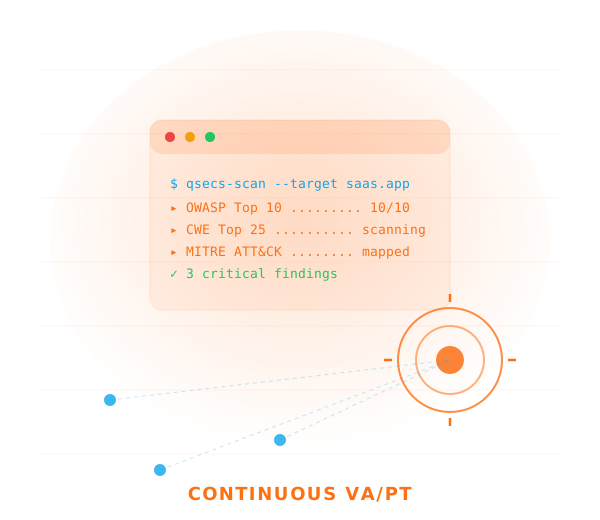
We assess each of the ten OWASP categories against your live application, mapping every finding to a concrete, reproducible exploit path.
The OWASP Top 10 distils years of breach data into the ten risk categories that cause the most real-world damage to web applications. It is the baseline every serious security program is measured against — and the first thing a knowledgeable attacker will probe.
QSECS treats the Top 10 as a starting point, not a checklist. We test each category by hand against your live application, then chain weaknesses across categories to demonstrate the kind of compound, high-impact compromise an automated scan will never find.
Broken access control — horizontal and vertical privilege escalation, IDOR, and forced browsing to restricted functions
Injection flaws — SQL, NoSQL, OS command, LDAP and template injection across every input surface
Cryptographic failures — weak algorithms, exposed secrets and transport weaknesses, assessed for post-quantum resilience
Authentication and session failures — credential-stuffing exposure, weak resets and session-fixation paths
SSRF, insecure design, misconfiguration and vulnerable components — tested end to end, not in isolation
Why the OWASP Top 10 Now Has a Legal Deadline
Cryptographic failures sit in the OWASP Top 10 for a reason — and quantum computing turns them from theoretical to terminal. Executive Order 14412, "Securing the Nation Against Advanced Cryptographic Attacks," now imposes legally binding federal deadlines to migrate to post-quantum cryptography: key establishment by December 31, 2030 and digital signatures by December 31, 2031. Finding every weak algorithm, exposed secret and broken access path before those dates — across code that changes weekly — is impossible with an annual manual pentest. QRedSentinel closes that gap by testing your application around the clock, so every new weakness surfaces the day it appears — not at next year's audit.
Our methodology pairs expert manual testing with Generative AI-accelerated reconnaissance so nothing in the Top 10 is missed.
We manually validate every automated signal to eliminate false positives and surface the flaws scanners can't reach
We chain individually low-risk findings into realistic, high-impact attack scenarios that mirror a determined adversary
We map each issue to its OWASP category, CWE identifier and CVSS score so prioritisation is unambiguous
We provide Generative AI-authored remediation guidance with concrete code- and config-level fixes for your stack
We retest after remediation to confirm every Top 10 finding is genuinely closed, not merely suppressed